

Just Good Business
Put your business at the centre. See where it can go.
Just Good Business, powered by SOSX, helps you grow, pivot and reduce risk: a comprehensive assessment of your business as a system of systems, with your cash and growth options tested on your own numbers, for people deciding whether to start, founders, owners, and anyone applying for a grant or investment.
The problems it solves
- “Should I even start this? What would have to be true?”
- “We’re busy. But where is the next pound of profit?”
- “How many months of cash do we really have?”
- “We need a grant or an investor. Where is our case weak?”
Just Good Business: Grow, pivot and reduce risk
See Just Good Business at work
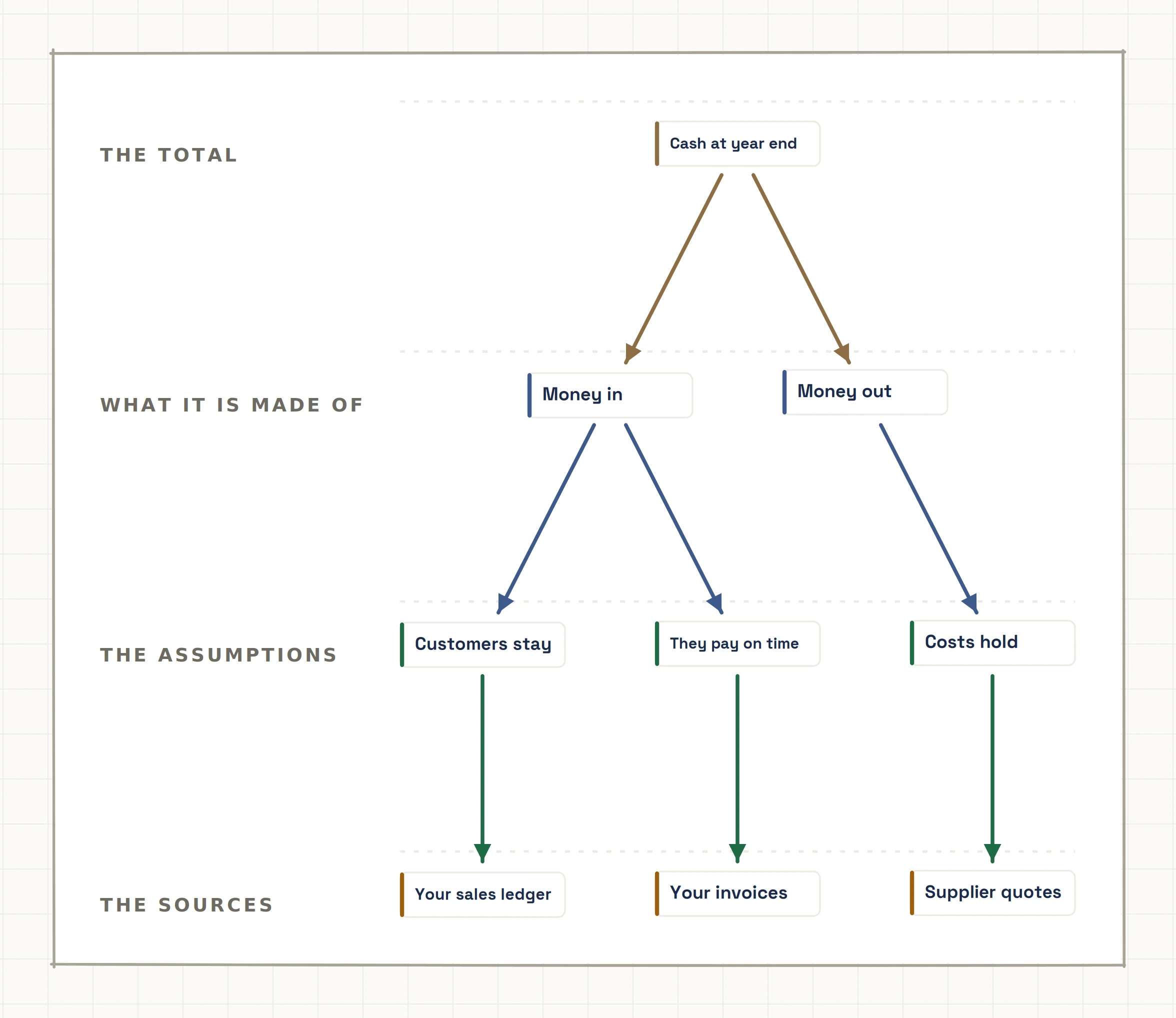
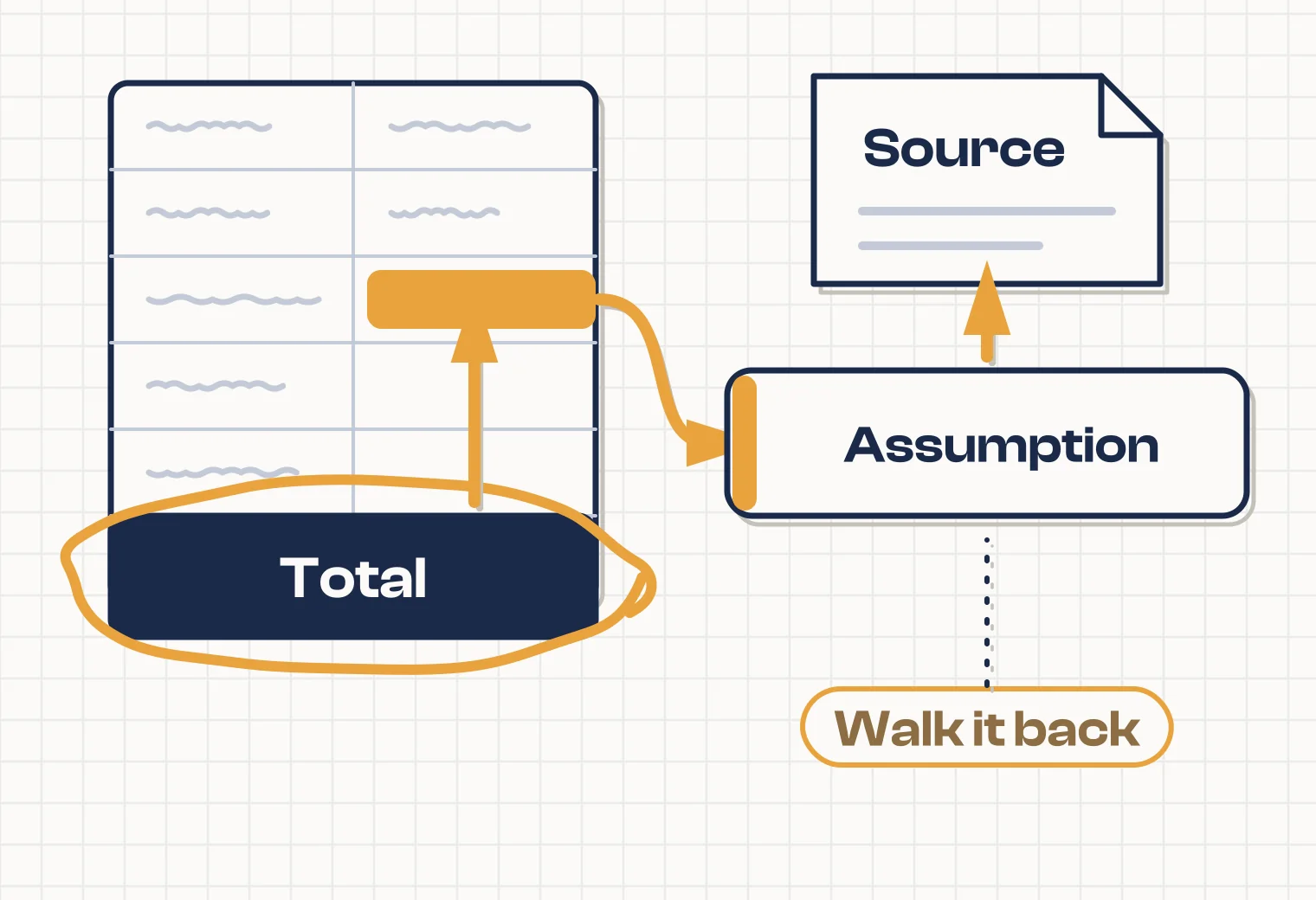
A total walked back to the assumptions underneath it, and to where each came from. 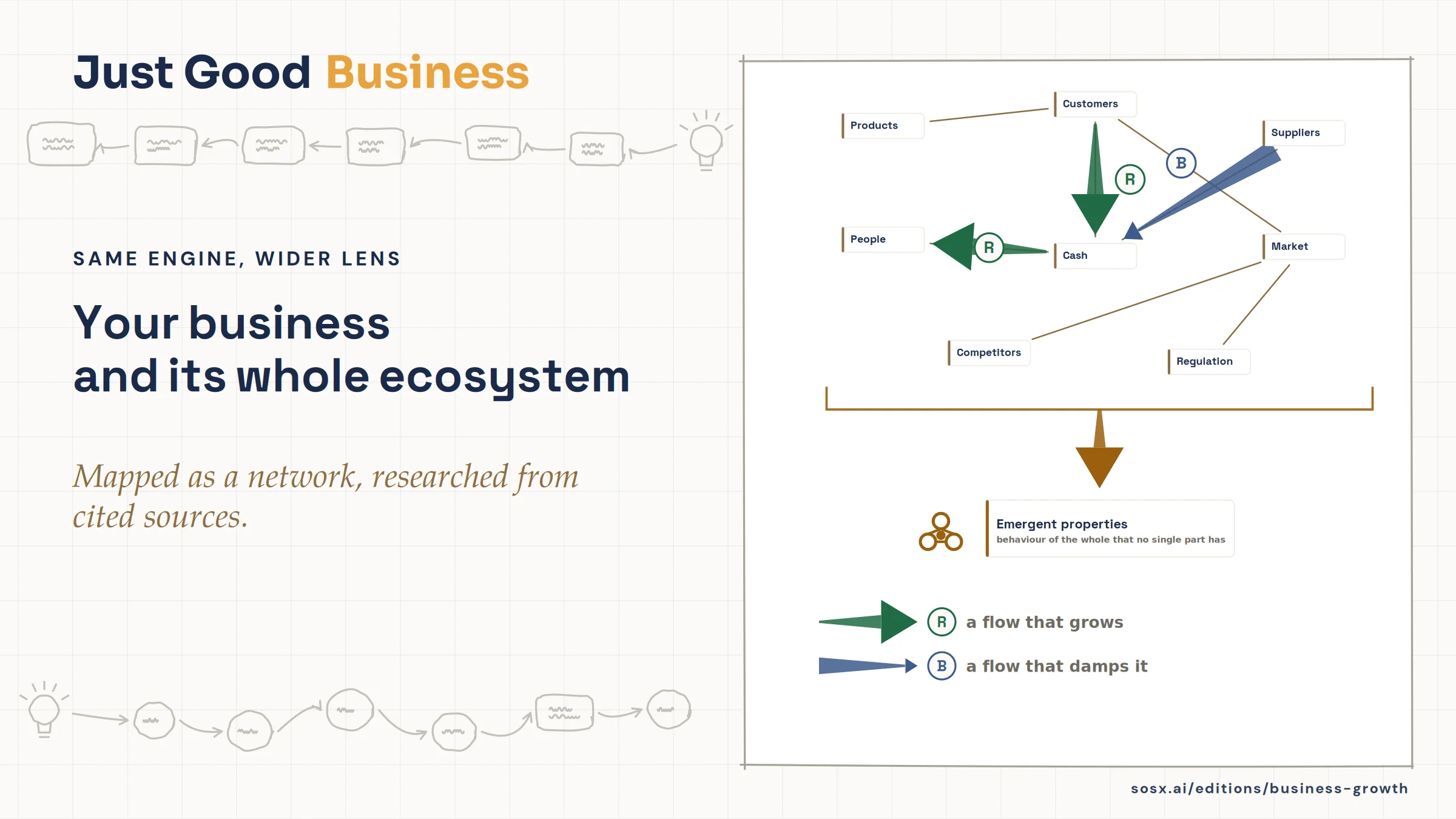
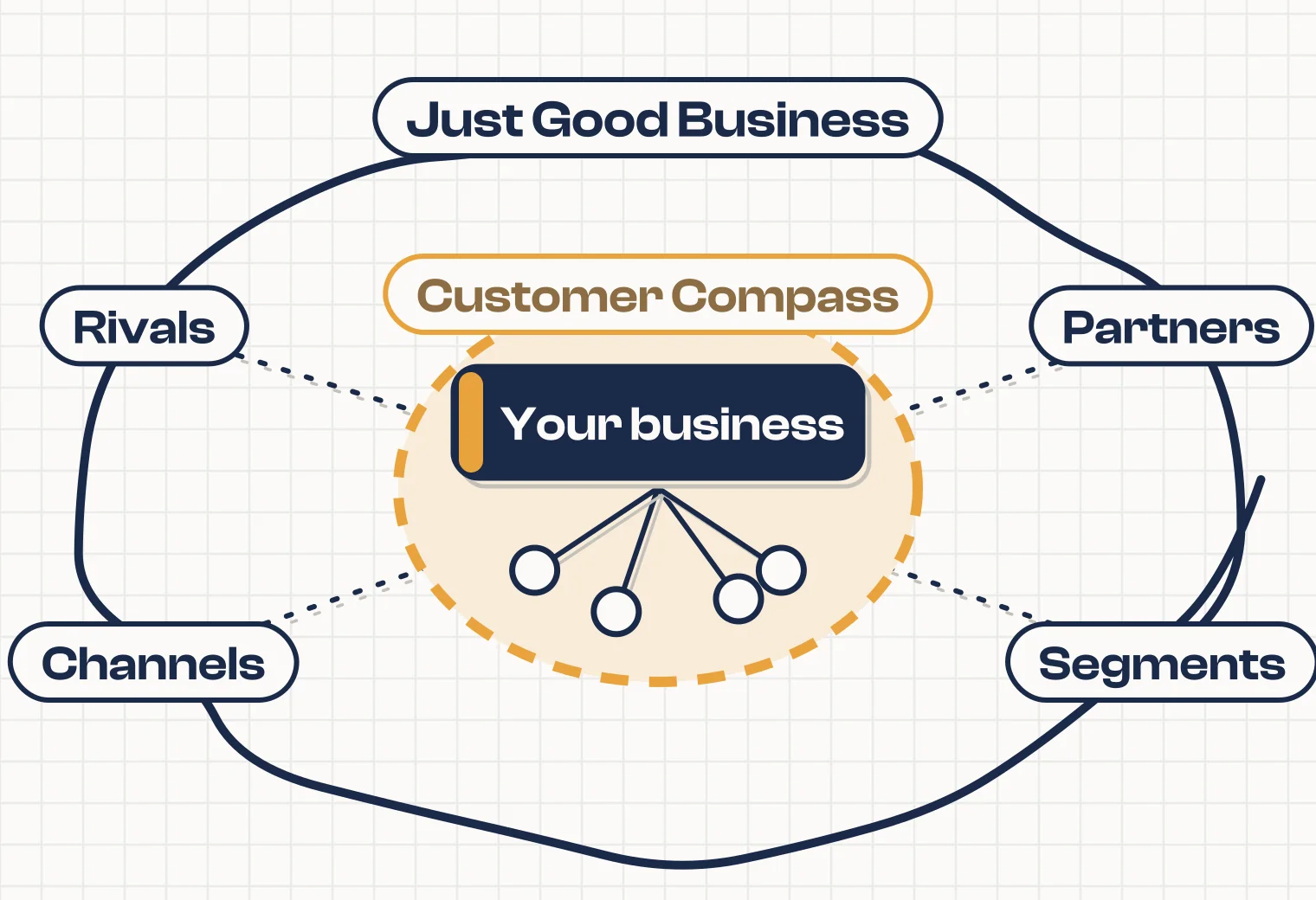
The business mapped as a connected network, with the flows that grow it and the flows that damp it. 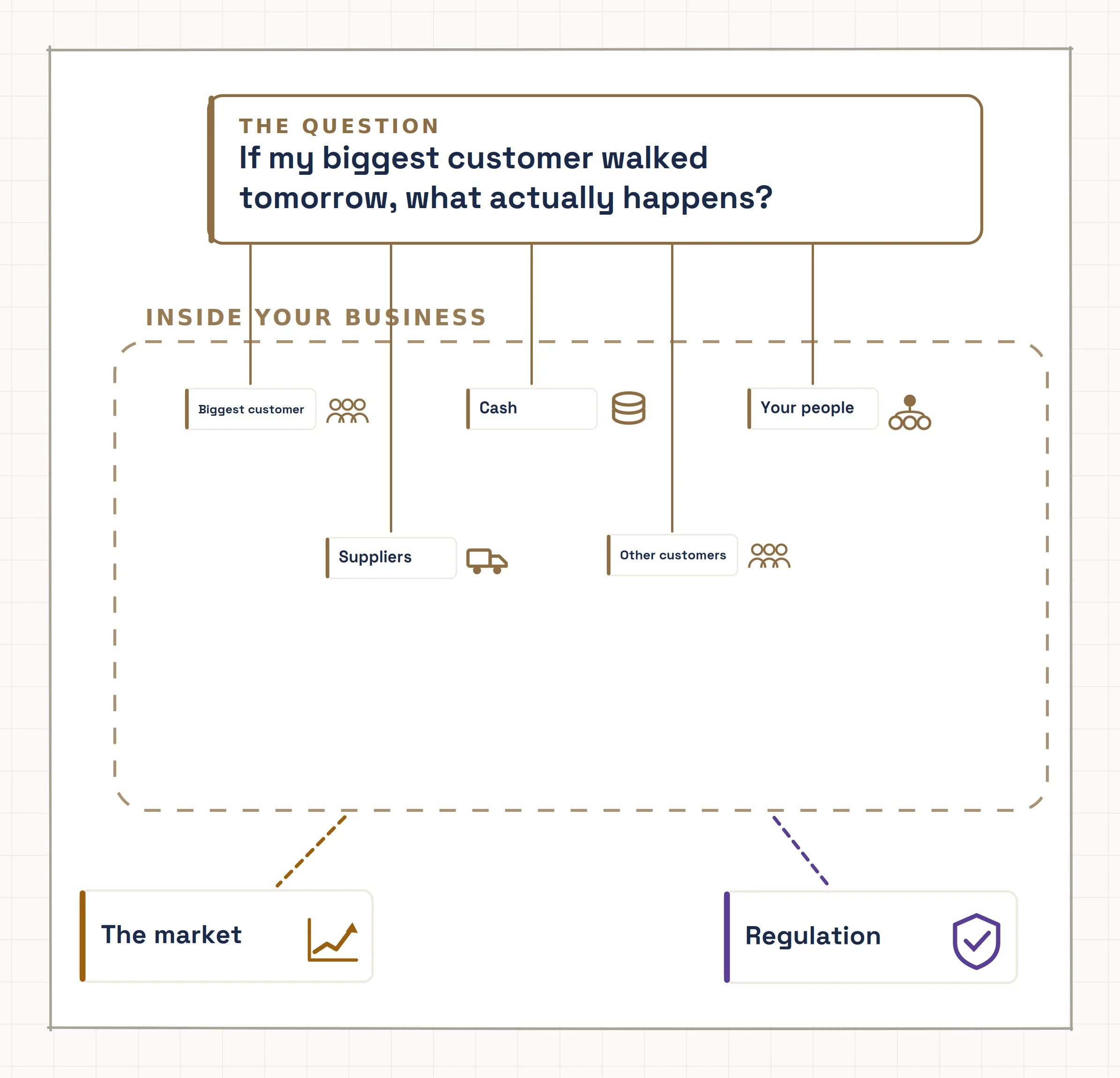
The owner's question, drawn as the network it reaches across. 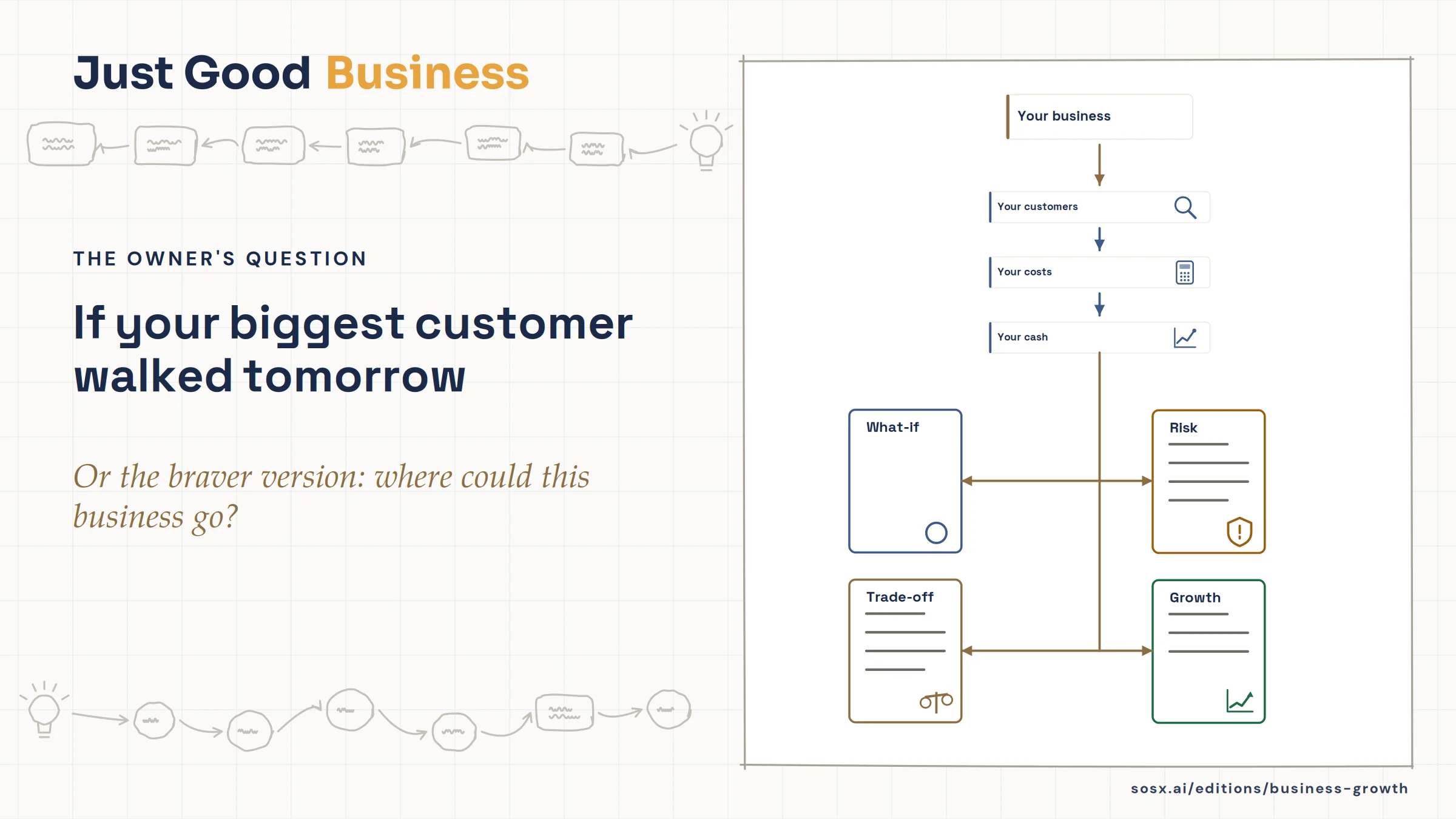
Your own customers, costs and cash, run through what-if, risk, trade-off and growth analyses. 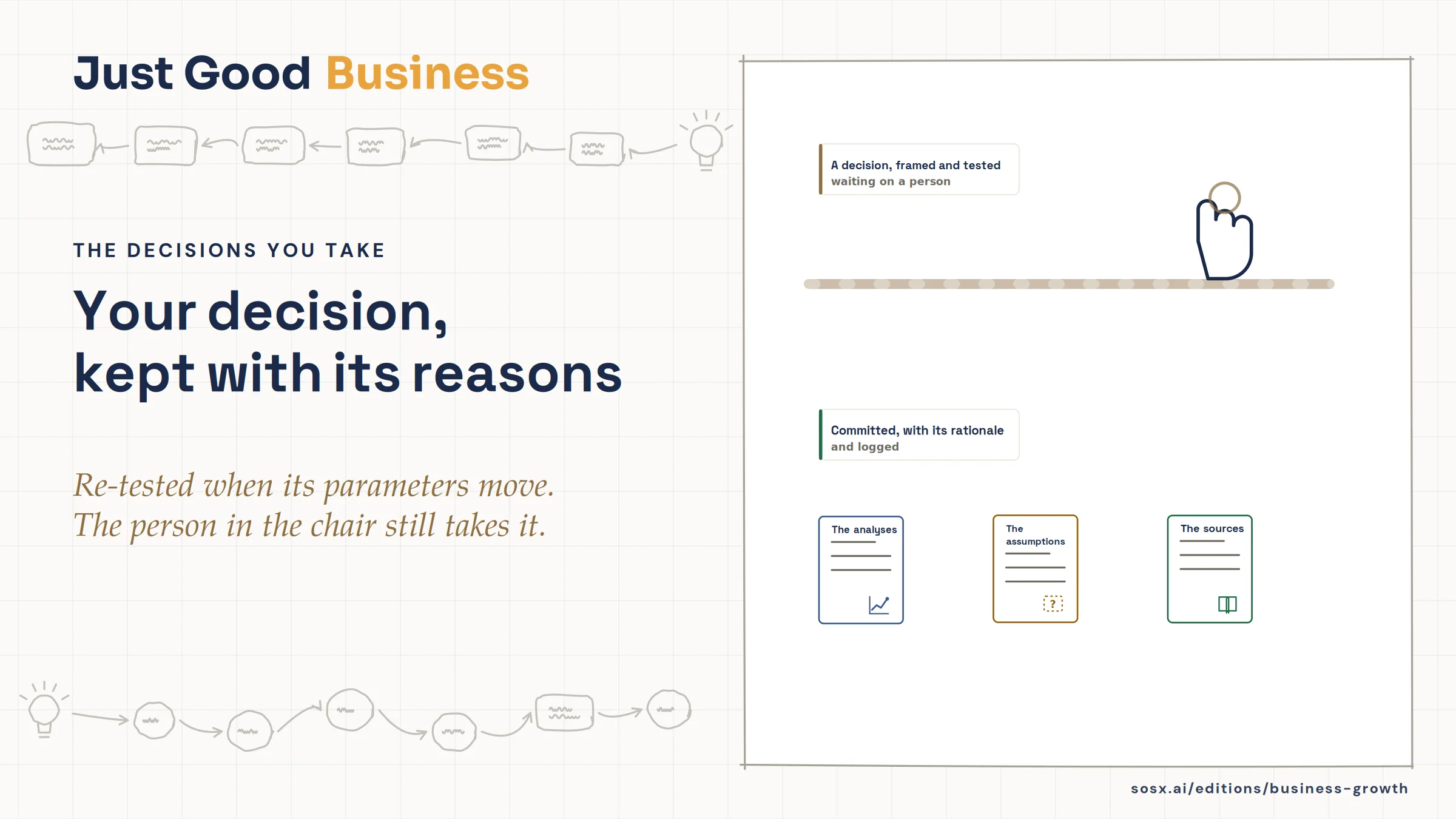
A decision committed by a person, with the analyses, assumptions and sources behind it kept for the re-test.

How SOSX helps
Research
Specialised agents research the question, every claim citing a source.
Build
One typed, connected network, every value with its units and confidence.
Analyse
One connected model, many analyses: trade-off, what-if, comparative and feasibility studies, and the emergent properties no single part shows.
Report
SWOTs, risk registers and decision reports, challenged and checked before you see them.
The detail
For when you want the whole argument.
Read moreWhat Just Good Business does
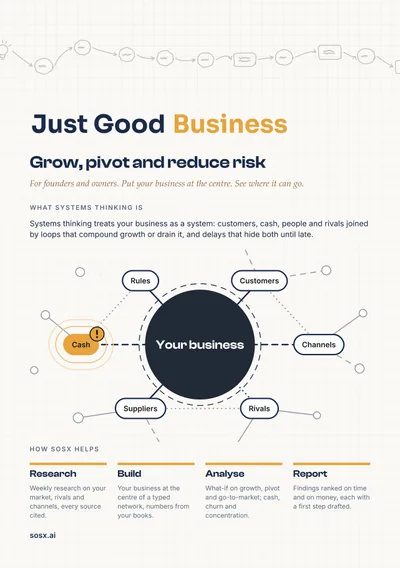
Put your business at the centre. Build out the ecosystem it operates in: customers, suppliers, competitors, channels, regulation. Then use it to grow, pivot and reduce risk. That is Just Good Business, powered by SOSX, and it is delivered as one thing: a comprehensive assessment of your business as a system of systems.
It works from where you are. If you have not started yet, it asks whether the business should exist before you spend your savings building it, and shows what would have to be true. If you are starting out, it helps you work out your go-to-market: which segment first, which channel, what price and which partners, tested before you spend. If you run an established business, it reads your numbers from your own books, shows how many months of cash you have under a bad year and a good one, and tells you early when the shape of the business needs to change. And if you are raising money, from a grant or an investor, it reads the business the way they will, and drafts the application from your own evidence.
The assessment covers every part of the business and the connections drawn between them, not one department at a time. Most of what goes wrong slips between departments, and the map shows the loops that compound growth or drain it. It scores what it finds three ways, and never blends them: the deterministic maths of your stocks and flows, an anchored self-placement, and an audit score, each shown for what it is. Every load-bearing claim carries its evidence grade, so a section is only as confident as its weakest claim and you can see which claim that is. Growth and pivot options are ranked on both of the objectives that matter, time and money, with both always shown. And every finding lands as an action with an owner and a date, because an assessment that ends in observations is a report, and this is a plan.
Plenty of tools now promise an AI operating system for your business. What makes one trustworthy is the formal model underneath it: a digital twin of a problem space, here your business and the ecosystem around it, that every recommendation is grounded in and can be traced back to.
The companion book, Just Good Business, teaches the whole method by hand: the book is the method, the service runs it for you, with the hours of attention it takes done by machine.
Underneath it are the principles proven in Customer Compass, our cash-flow product. The maths is deterministic. The AI narrates but never invents numbers. Every insight comes with a drafted first action. You approve every step. Honesty guardrails as code, not as a promise.
Customer Compass's own features come with it. Your Xero data fills the numbers, with no re-keying. Every client lands in Keep, Grow, Renegotiate or Review. The top-client stress test, the cash forecast, silent churn, price ceilings and revenue at risk all feed the wider map, kept current on a schedule you set, and the moves worth making arrive ranked by what they are worth, each with its first step drafted for you to approve.
The proof point, exactly as it stands: Winner — Cash Flow Accelerator category, Xero Rise of the Builder Hackathon 2026. Judged by Xero. Customer Compass is live in the UK since July 2026; its Xero App Marketplace status is "submitted".
Read moreThe discipline: the numbers work most owners never get taught
There is a management-accounting practice behind good business decisions, and it long predates any of this. Know your contribution per job and your break-even, so you can tell the difference between busy and profitable. Trace overhead to the work that actually causes it rather than smearing it across everything. Plan with a budget you then read the variance against, because the gap between plan and actual is the only feedback loop most small businesses have. Forecast with a stated margin of error rather than a confident single line. Look at performance across every area the business depends on, Drucker's list still holds up, not just the one that is easy to measure. And when growth starts to hurt, recognise the crisis for what it is: Greiner's phases describe the way an organisation outgrows the way it is run.
All of that can be done in a spreadsheet by anybody willing to be honest with themselves, and plenty of good businesses run exactly that way. Two things make it expensive. The first is upkeep: a model is only true on the day you build it. The second is quieter. Independent studies of real spreadsheets found error rates high enough to be a governance problem in their own right: Freeman, "How to make spreadsheets error-proof" (Journal of Accountancy, 1996), and Panko and Halverson, "Spreadsheets on trial: a survey of research on spreadsheet risks" (HICSS-29, 1996), which synthesises the field, large spreadsheets very frequently contain at least one material formula error, and the people using them are confident anyway.
That is research about spreadsheets, not a comparison with anything of ours, and it is not an argument against them: we run plenty. It is the argument for numbers that carry where they came from, so a total can be walked back to the assumption underneath it: which is what the next section is about.
Read moreSame engine, wider lens
Customer Compass watches a business and its clients. Just Good Business extends the same platform to the business and its whole ecosystem: it maps your business as a connected network, researches it from cited sources, and runs grounded analyses: what-if, trade-off, risk. Compass proves the principles at the scale of the business and its customers; Just Good Business runs the same discipline across the business and everything it operates in.
Read moreHow it helps: the whole business, on your own numbers
- Your business on one map, in your own words. The business sits at the centre with the ten systems around it: customers, rivals, suppliers, channels, rules, lenders, people, tools, community and you. Every connection reads as a sentence ("Client A buys from the business"), so you see the whole business before deciding what to change.
- Every claim graded by its evidence. Each one is marked by analogy, from research, from data, or a paying customer, and every open section names the one step that would raise it. Anything the AI suggests stays a suggestion until you confirm it, so nothing a machine writes becomes a fact about your business without your yes.
- Your cash, tested before it runs short. Drop in a bank export and your invoices, and the cash budget runs month by month under worst, base and best cases drawn from your own history, with what happens if customers pay later or sales dip. Runway is a standing number, so you know how many months you have and what breaks first.
- Which work actually pays. Contribution per hour of whatever you are shortest of, break-even, and where break-even moves when you hire. The bottleneck is found from your own job records, and your fixes are put in the order that frees it.
- Your market sized from buyers you can count. The bottom-up count sits beside the published figure, with what separates them, so you know which number to plan against. Rivals, their prices and the value your customers get sit in one grid, every cell sourced.
- Growth options ranked on time and on money. Eight to fifteen options along the lines the business already has, each run through the cash model under worst, base and best cases, and ranked by whichever you are shorter of, with the other always beside it. The top three are attacked before you commit: the demand they need, the break-even volume, and the smallest honest test.
- Finances kept private. Your money is visible only to you and the people you name, such as your accountant or a co-founder, so you can use the whole assessment with your team without sharing your accounts.
- Re-run it and see what moved. Come back in six weeks with fresh numbers: the assessment re-runs, shows exactly what changed, and raises any measure drifting from plan as a finding with a next step.
Read moreShould you start it? What would have to be true
Most new businesses are tested by spending the savings. Just Good Business tests the idea first. Four gates come before anything else: is the problem felt, is there a solution, do people already pay for solutions like it, and would they buy from you. The fourth is the one most often skipped, so it always shows the evidence behind it.
Then it builds a "what would have to be true" sheet from your own answers. You: the roles the business needs, and which you can cover. Living costs: how many months your savings carry you, and how much you could lose without harm. The market: the buyers you can actually reach, and the commitments you have so far. The first year's cash: the month cash is lowest and how deep the dip goes, the margin at the volumes you choose, and whether your lowest workable price sits under what buyers will pay. Each gap comes with the cheapest next test that would close it.
There is no verdict and no score. You record your own decision: go on, test more, or stop for now. Go on, and everything you have gathered carries straight into the start-up route.
Read moreRaising money: read the way an investor or a funder reads it
For an investor, Just Good Business reads your business on the seven things an investor weighs: team, market, product, traction, business model, competition and the ask. It lists what they will ask to see and which of it you already have, gives a valuation as a range with every assumption beside it, never a single number, and ends in a "what must be true" tree of the conditions your case rests on. It shows how you come across when an investor looks you up, and where that costs credibility. It drafts a pitch from the finished assessment, then puts it through the questions investors actually ask, so the gaps surface before the meeting does. Enter an offer's terms and it shows what each side receives across a range of exit values, with the questions to take to your adviser.
For a funder, it reads the business the way a funder's assessor does, criterion by criterion, with the evidence behind each answer and what is still missing. It works with Innovate UK grants and contracts for innovation, European Commission calls, cluster calls and any other funder whose call you bring. Paste the competition's address, and it reads the competition and the documents that matter, lists every question with its limit and what assessors look for, and checks each eligibility gate as met, not met or not known, with the grant shown paid in arrears against your own cash. You decide whether to bid.
Then it drafts the application from your own evidence. You are asked only what your map does not already answer. Each answer is written to its limit, every claim points at your evidence and every figure comes from your records, and anything unproven is marked for you to confirm or provide. A panel of hostile readers, who see only your answers, gives the strongest objection to each one, and says whether you can fix it by rewording or need to go and get something: a letter, a quote, a hire. The finished application exports to Word in the funder's question order.
It never tells you that you will win, and it never submits for you: you stay the applicant, with a document you can stand behind.
Read moreThe question an owner asks
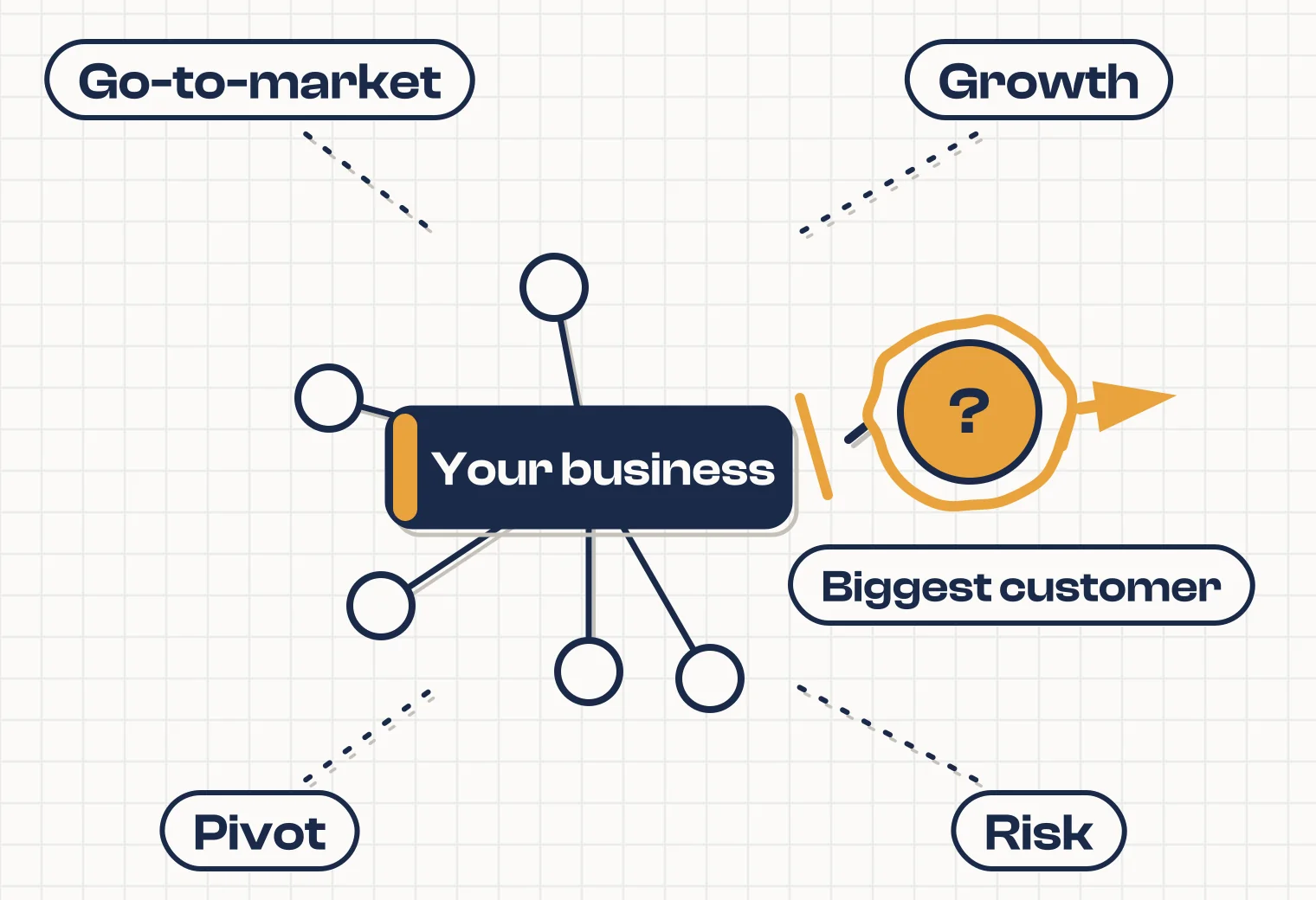
If my biggest customer walked tomorrow, what actually happens, and what should I already be doing about it? Or the braver version: where could this business go that we have never priced up? Those are systems questions, and they are the assessment's home ground: model the ecosystem, assess the chances of success or failure, describe the mitigations, and put evidence you can interrogate under the opportunities: expansion, pivot, or hold.
Take a design studio with one client carrying much of its fees, an illustrative case. The cash budget shows how many months cash lasts if that client leaves, under a bad year and a good one. The growth options show which move fills the gap fastest, ranked on time or on money, whichever the studio is shorter of. And if the move needs outside money, the funder view shows where the case is already strong and what an assessor would ask for next.
Five questions, one model
- Go-to-market. Which segment first, and through which channel? Segments, channels, rivals and partners on one map, the market sized from buyers you can count, and the channel tested on a twin of the business before you spend, every source cited.
- Growth. Where is the next pound of profit? Your clients sorted from your own books, growth options ranked on time and on money, and the price rise or the hire tested first.
- Pivot. Is the shape still winning? The warning signs checked on a schedule, so a pivot is seen early, from strength.
- Risk. What breaks first? The top-client stress test, cash under worst, base and best cases, and runway as a number you can watch.
- Funding. Would an investor or a funder back this? The business read the way they read it, the gaps shown before they find them, and the application drafted from your own evidence.
Read moreThe decisions you take, kept and re-tested
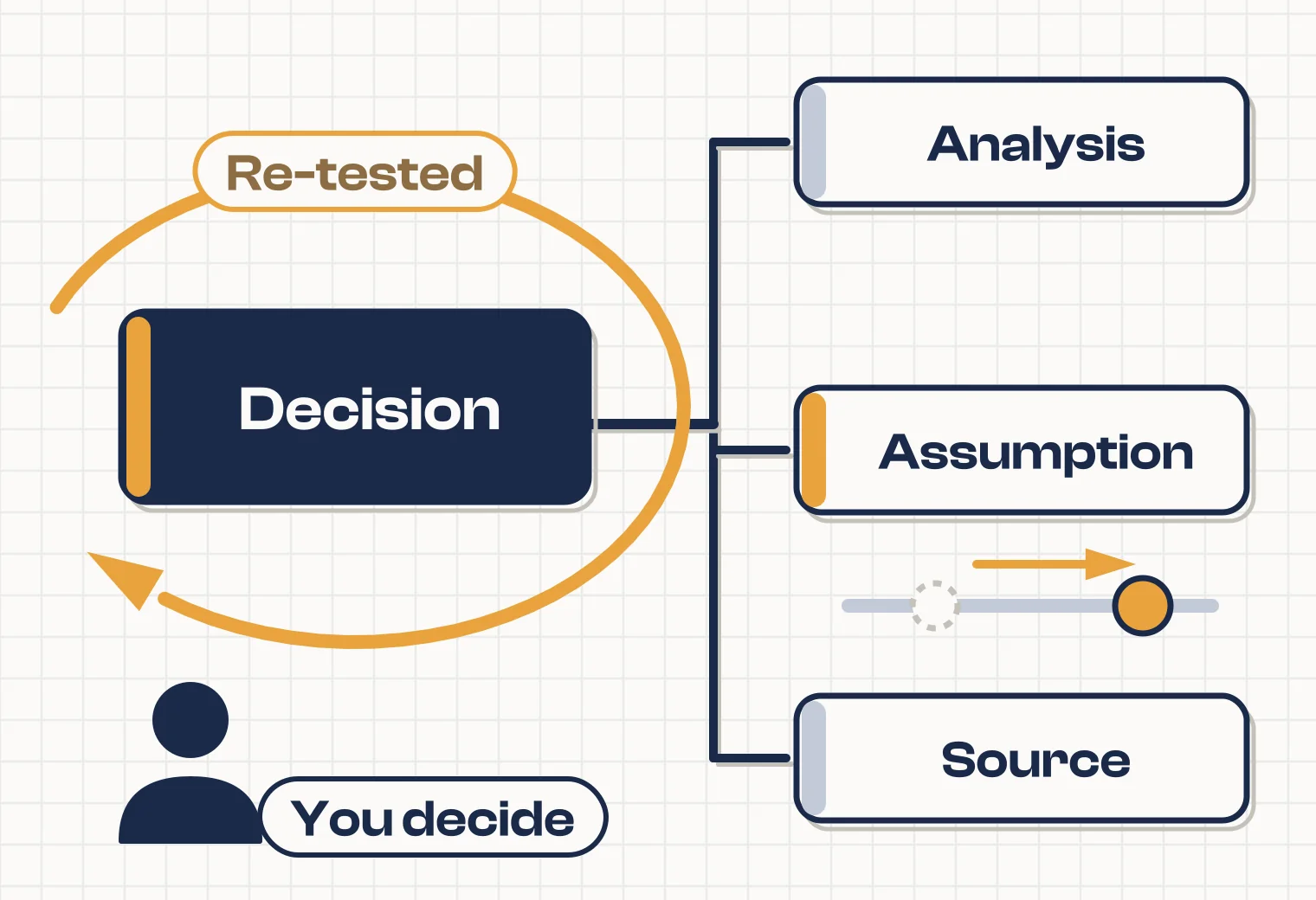
Growth, pivots and holds are decisions, and Just Good Business treats each one as a system. The decision is framed with the ecosystem it lands in built out around it, the options are tested before anything is committed, and the load-bearing assumptions are hunted by adversary agents rather than hoped for. Every claim cites a catalogued source, and judgement, formal proof and computation stay visibly separate.
Then the decision itself is kept. A committed decision carries its rationale chain (the analyses, parameters, assumptions and sources behind it) and is re-tested when those parameters move materially. That is the difference between a decision you can revisit and a slide deck you can only re-read. Just Good Business supports the decision; the person in the chair still takes it.
Free to download
Go deeper
Bring us the question you keep asking
We meet a lot of businesses where innovation feels like a luxury, something for when times are better, when actually it could be the thing that saves them. The offer here is a conversation, not a pitch: tell us the question that keeps coming back, and we'll tell you honestly whether this is for you.
Send us your question and let's have a chat.